MosaicLand

a symphony of information, a wonderland for those who seek to learn...

Showing posts with label fact. Show all posts

Wednesday, July 28, 2010

Mirror of the Universe -- Antimatters

At the beginning of our universe, there was a big bang...
At that point, particles are created from virtually nothing...
What are particles made out of?
This question troubled scientists for centuries...
Scientists investigating the structure of subatomic particles are just like cavemen investigating the structure of stone...
To investigate what are stones made up of, cavemen bring two stones together, colliding them...
To investigate what subatomic particles are made up of, scientist do the same thing......


Have you ever heard of the LHC?

http://graphics8.nytimes.com/images/2007/05/14/science/15cern.xlarge1.jpg


If you are an avid reader, or if you had watched the movie 'Angels and Demons', no doubt, you would know what it is...

LHC, or Large Hadron Collider is  a particle accelerator located underground in Geneva, Switzerland.
This gigantic machine/research facility
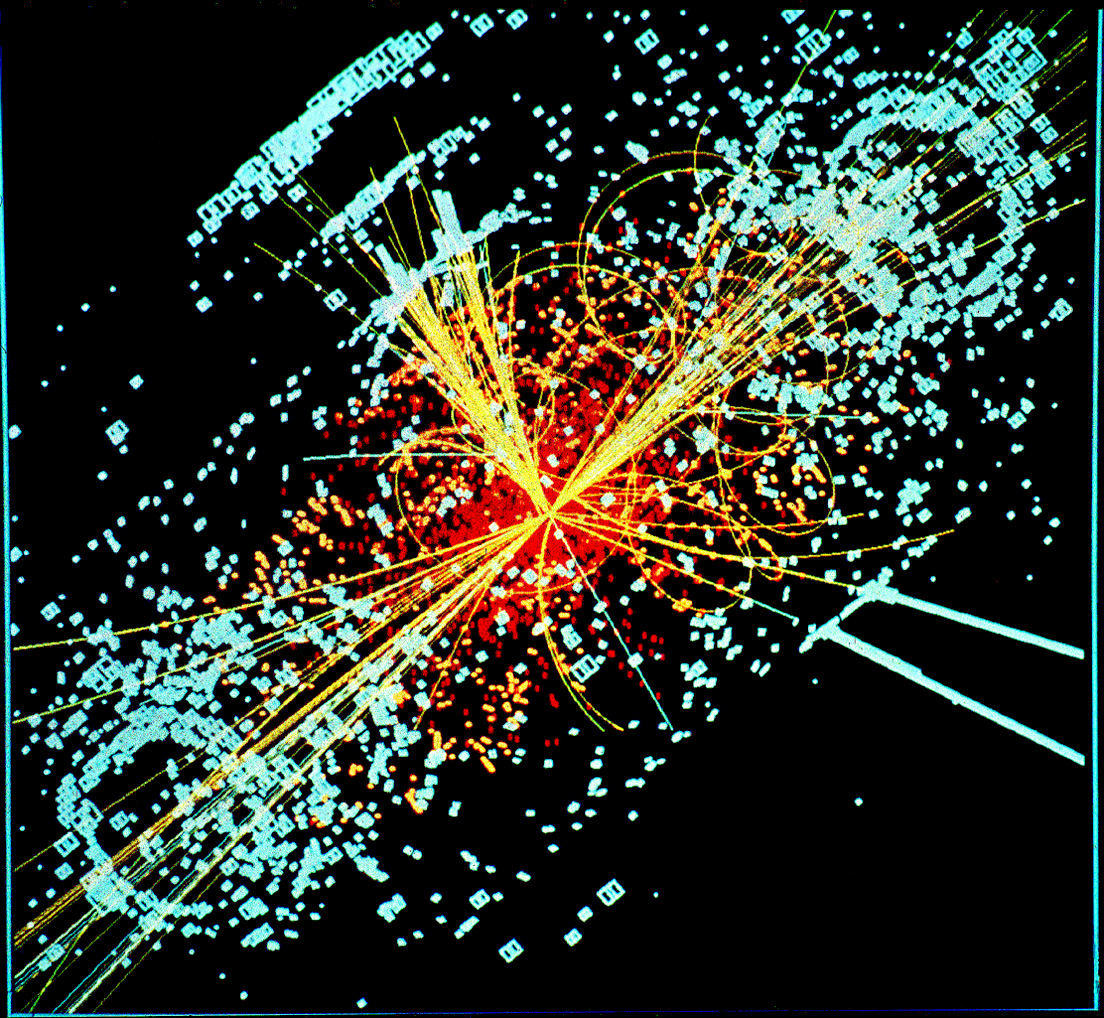
http://upload.wikimedia.org/wikipedia/commons/1/1c/CMS_Higgs-event.jpg
Higgs Bosons created in a particle collision
In the LHC, experiments are constantly carried out to investigate the nature of matter.

http://www.ift.uam.es/en/system/files/lhc_hall_1.jpg
 Superconducting magnets in the collider accelerates particles such as protons to bear 99.9% the speed of light in opposite directions

When these particles collide, scientist could then obtain information about the structure of the subatomic particles.

In November 2008,  Lawrence Livermore National Laboratory announced that they had successfully produced antimatter in the form of positrons (the opposite of electron)


So, what exactly are these anti-matters?


Fundamental physical particles are defined by their mass, charge and magnetic moment (interaction with magnetic field).


Matter as learnt by any secondary-school student, has mass, occupies volume and are made up of particles.


http://spm-chemistry.wikispaces.com/file/view/states_of_matter.gif/32349521/states_of_matter.gif
The different state of matter


These particles such as atoms or ions are made up of even smaller particles such as electron, proton and neutron.


http://www.biocrawler.com/w/images/d/d8/Atom_diagram.png
Subatomic particles of an atom


Different elements has different structures made up from subatomic particles.
For example, hydrogen is made up of one proton and one electron, where the electron orbits around a nucleus made up of one proton
Helium,on the other hand, is made up of two proton, two electrons and two neutrons where the two electrons orbits around a nucleus made up of two protons and two neutron held together by nuclear strong force.


For antimatters, the same rules apply, but with anti-particles. For instance, an anti-hydrogen is made up of a positron (positively charged electron) orbiting around an antiproton. While an anti-helium is made up of two positrons orbiting around a nucleus made up of two antiprotons and two antineutrons.


http://www.futuretimeline.net/22ndcentury/images/antimatter-power-plant.jpg
Antimatter-matter annihilation reaction
When an antiparticle meets its counterpart (the particle), they destroy each other completely in a process known as annihilation. This process converts the masses of the antiparticle and particle into energy and releases high energy gamma ray photons.
https://blogger.googleusercontent.com/img/b/R29vZ2xl/AVvXsEhXODLhfTW8sq69ZGtnqKssoaidHN8gTPXA7okl6eohKmBmzrRY3nFAzttdahXJwoQ5Esq3Ghn6MFJq2MBdEco55ICVWV5osWsaOnGafCGiQMZ9ID7MAEdiqJ-qlOOg4KEo2aWvBN864GE/s1600/matter-and-energy-Physics-e=mc2.jpg


The total amount of energy release in this reaction is governed by the formula, E=MC^2 where E is the total amount of energy released, M is the combined mass of the matter and anti-matter, and C^2 is the speed of light squared.


Since annihilation process is a 100% efficient reaction, the energy released is stronger than nuclear reactions.


In nuclear reaction, the total mass loss is a fraction of the total mass, for example, when uranium undergoes radioactive decay, it is transmuted into plutonium that has a lower mass. The loss mass in this reaction appears as high energy gamma rays released, alpha and beta emission.


In antimatter-matter reaction, the total mass loss is equal to the total mass annihilated which, in turn, is the total amount of mass in the whole reaction.


To understand more about the LHC and Antimatter, listen to the song below:


As a conclusion, it is save to assume that Antimatter may, one day, replace all other sources of energy as the cleanest source of energy. 

Tuesday, July 27, 2010

Canine - men's best friend!!

MosaicLand, home to the most elusive Mosaic Dog...
A weird dog species that is said to have all the knowledge about real-world dogs.....


Talk about weird dogs...
I remember reading about them a few weeks ago....
These are a few dogs that I remembered from my read.....

Basenji


http://static.squidoo.com/resize/squidoo_images/590/draft_lens3540782module64812921photo_1256394550dog1.jpg
http://www.kennels.co.uk/images/Basenji2.jpg

The Basenji is a native dog of Africa....
What makes it so unique when it looks just like any other dogs?
Well, the Basenji does not bark. In fact, it is the only known species of dog on Earth that doesn't bark!

Great Danes


http://puppies-and-dogs.com/images/great%20dane%20puppies%20and%20dogs.jpg

http://daneanne.com/images/Great-Dane-and-Chihuahua.jpeg

The great dane is a notable dog due to its height.
Originally bred in Germany about 400 years ago for hunting.
An average adult great dane can reach up to 81 centimeters high at the shoulder


Chihuahuas


http://www.pictures-of-puppies-and-dogs.com/images/breed/Chihuahua-big.jpg
http://static.howstuffworks.com/gif/chihuahua.jpg
The Chihuahua was named after a Mexican mining town.
It is one of the smallest breed of dogs on earth.
Other dogs of similar sizes includes the toy poodle and the Yorkshire terrier.

Doggy Facts


Why do dogs bury bones?


http://www.diamondsintheruff.com/DIG6.JPG


It is believed that when dogs are still living in the wilderness, they are always threatened by other animals such as wolves, tigers and even other dogs.

Therefore, they usually eat as fast as possible and bury any leftovers for the future.

Experts also belief that burying a meaty bone underground softens the meat, making it easier for the dog to chew on.

Although domesticated dogs living today need not do this, the habit remains.

Why do dogs turn around before lying down?

http://www.itchmo.com/wp-content/uploads/2007/10/6-1-07.jpg
http://www.zastavki.com/pictures/1024x768/2008/Animals_Dogs_Sleep_so_Well_005506_.jpg


Again, the story begins long time ago when dogs are still wild. In the wilderness, dogs would turn round and round before lying down on the grass. This action softens the grass, making it more comfortable for the dogs to sleep on.

However, even though comfortable beds has been prepared for dogs nowadays, their old habit still remains.


Pitcher Plant

Carnivorous plants never ceased to amaze me...
Most plants obtain their nutrients from the sunlight...
These plants however, obtain them from insects and animals..
I wonder, is there any human-eating plants?


In the thick and dense Sarawakian forest, pitcher plants are found in abundant.

http://www.mongabay.com/images/indonesia/kalimantan/kali9838.JPG
The pitcher plants grows elaborate pitchers at the tip of their leafs.
These pitchers are filled with sweet-smelling liquid which is akin to honey.

Attracted by this smell, insects may land on the rim of the plant to investigate.
At the rim of the plant, insect will find some sweet liquid. This sugary liquid was secreted by the pitcher plant to encourage the insect to stay.

Once the insect decided to investigate further, the shape of the pitcher plant will cause it to fall into the liquid inside the pitcher plant.

A bug trapped in pitcher plant
http://ucanr.org/blogs/bugsquad/blogfiles/896.jpg
 The pitcher plant have inward-curving hairs and slippery walls that prevents insects from escaping from the pitcher.

Slowly, the insect will rot inside the pitcher, while the nutrients of the insects will be absorbed by the pitcher plant.
Copyright 2010 Gabriel Ling. Powered by Blogger.

Spider

Penguin